


Effects of Sugarcane Molasses Concentration and Cultivation Strategy on Bacterial Cellulose Yield and Properties
Main Article Content
Nurijawati Nurijawati
Sarkono Sarkono
Dhony Hermanto
Background: Bacterial cellulose (BC) is a promising biomaterial whose yield and physicochemical properties depend on cultivation conditions.
Aims: This study investigated the combined effects of sugarcane molasses concentration and cultivation strategy on BC yield and material properties using Gluconacetobacter sp. SAL-53.
Methods: A 4 × 4 factorial design was employed, comprising four molasses concentrations (3, 6, 9, and 12%, w/v) and four cultivation conditions: static culture and agitation at 100, 150, and 200 rpm. BC was produced for 14 days and evaluated for dry yield, tensile strength, Young’s modulus, water absorption capacity, water-holding capacity, electrical conductivity, biodegradability, surface morphology, and chemical structure.
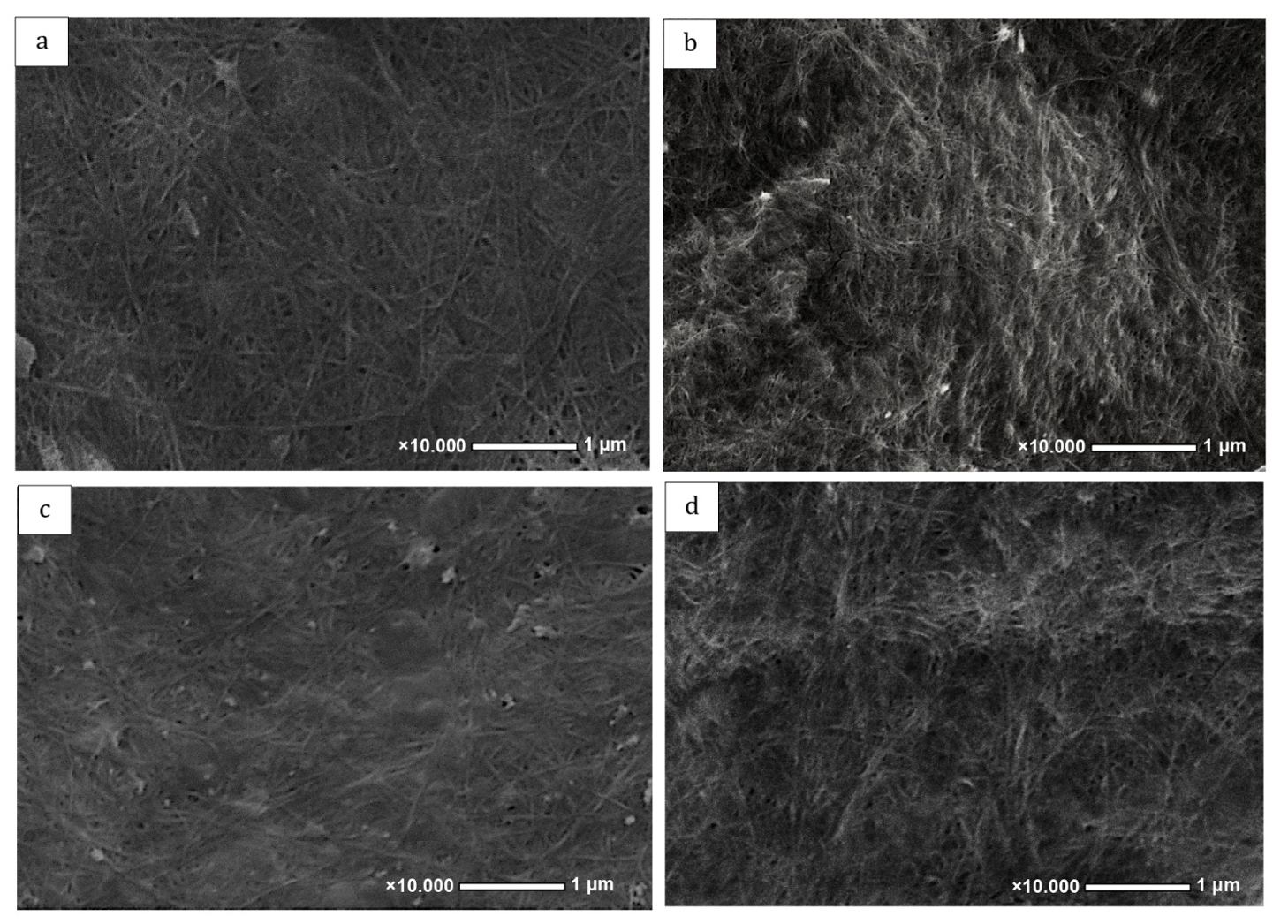
Results: The highest dry BC yield was 51.50 ± 0.26 g L⁻¹ at 6% molasses and 100 rpm. Agitation at 200 rpm produced BC with a tensile strength of 52.80 MPa and a Young’s modulus of 720.40 MPa, with comparatively high electrical conductivity. FTIR analysis showed characteristic cellulose-associated functional groups across the analyzed samples, while SEM revealed differences in surface morphology. Two-way ANOVA and Tukey’s Test indicated a significant overall effect of the experimental treatments on the combined physicochemical response (p < 0.001).
Conclusion: Molasses concentration and cultivation strategy significantly influenced BC yield and physicochemical properties. The molasses concentration of 6% at 100 rpm agitation is the optimum condition for yield, whereas 200 rpm produced BC with greater mechanical strength and electrical conductivity. These findings show that molasses is a feasible low-cost substrate and that cultivation strategy can be adjusted to obtain BC suited to different applications.
Alidu, M., & Alexander, S. L. M. (2026). Bacterial Cellulose Production : Decoupling Yield and Structural Quality in Refined and Waste-Derived Carbon Sources. Fermentation, 12(336), 1–33. https://doi.org/10.3390/fermentation12070336
Amorim, J., Liao, K., Mandal, A., Costa, D. S., Roumeli, E., & Sarubbo, L. A. (2024). Impact of Carbon Source on Bacterial Cellulose Network Architecture and Prolonged Lidocaine Release. Polymer, 16, 3021. https://doi.org/10.3390/polym16213021
Andrade, I. De, Fernandes, A., Cristina, A., Rampazzo, V., Gonçalves, D., Sarah, M., Ozaki, C., Maria, G., Windson, C., & Haminiuk, I. (2020). Bacterial cellulose : From production optimization to new applications. International Journal of Biological Macromolecules, 164, 2598–2611. https://doi.org/10.1016/j.ijbiomac.2020.07.255
Aydin, M. S., Yamada, S., Mohamed-ahmed, S., Rashad, A., & Mustafa, K. (2026). Influence of scaffold porosity on the degradation of 3D-printed biodegradable polymers : Coupled bioreactor , modeling , and in vivo validation. Materials Today Advances, 30, 100804. https://doi.org/10.1016/j.mtadv.2026.100804
Cakar, F., Ozer, I., Aytekin, A. Ö., & Fikrettin, S. (2014). Improvement production of bacterial cellulose by semi-continuous process in molasses medium. Carbohydrate Polymers, 106, 7–13. https://doi.org/10.1016/j.carbpol.2014.01.103
Çalhan, A., & Hasanoğlu, A. (2026). Bacterial cellulose as a next ‑ generation membrane material for selective transport: properties, fabrication, and applications. In Cellulose (Vol. 33, Issue 3). Springer Netherlands. https://doi.org/10.1007/s10570-025-06926-9
Chen, H., Huang, Y., Wang, F., Fu, Z., Li, A., Abdelsadig, M., Brassil, M., Xia, Y., Zhou, B., Du, G., & Fan, M. (2026). Recent advances in nanocellulose scaffold membranes : Sources , processing and functionalization. Materials Today Bio, 38, 103221. https://doi.org/10.1016/j.mtbio.2026.103221
Cristina, A., Martins, D., Silva-carvalho, R., Marques, S., Dourado, F., & Gama, M. (2026). Nanobubble-enhanced oxygen transfer in bacterial nanocellulose production : Comparative evaluation with static and airlift systems. International Journal of Biological Macromolecules, 346, 150572. https://doi.org/10.1016/j.ijbiomac.2026.150572
Espindola, S. P., Pronk, M., Zlopasa, J., Picken, S. J., & Loosdrecht, M. C. M. Van. (2021). Nanocellulose recovery from domestic wastewater. Journal of Cleaner Production, 280, 124507. https://doi.org/10.1016/j.jclepro.2020.124507
Fabijanski, M., & Garbarski, J. (2026). The Influence of Cellulose Fiber Content on the Mechanical Properties of Composites Based on Modified Thermoplastic Starch. Processes, 14(1480), 1–16. https://doi.org/10.3390/pr14091480
Fang, L., Zhou, Y., & Huang, Q. (2025). Ionic Conductive Textiles for Wearable Technology. Advances Materials, 37, 2502140. https://doi.org/10.1002/adma.202502140
Fuentes, R. O., Figueiredo, F. M., Marques, F. M. B., & Franco, J. I. (2001). Influence of microstructure on the electrical properties of NASICON materials. Solis State Ionics, 140, 173–179. https://doi.org/10.1016/S0167-2738(01)00701-9
Gomes, P., Silva, N. H. C. S., Trovatti, E., Duarte, M. F., Silvestre, A. J. D., Pascoal, C., & Freire, C. S. R. (2013). Production of bacterial cellulose by Gluconacetobacter sacchari using dry olive mill residue. Biomass and Bioenergy, 55, 205–211. https://doi.org/10.1016/j.biombioe.2013.02.004
Hapsari, D. P., Perdani, C. G., Fahmi, F., Nurika, I., & Gunawan, S. (2024). BNC production of siwalan neer and sugarcane molasses as novel media sources. Advances in Food Science, Sustainable Agriculture and Agroindustrial Engineering, 7(2), 141–149. https://doi.org/10.21776/ub.afssaae.2024.007.02.3
Ji, K., Wang, W., Zeng, B., Chen, S., Zhao, Q., Chen, Y., Li, G., & Ma, T. (2016). Bacterial cellulose synthesis mechanism of facultative anaerobe. Scientific Reports, 6, 21863. https://doi.org/10.1038/srep21863
Kumar, U. V., Narayanasamy, S., & Uthandi, S. (2025). Bacterial cellulose: A comprehensive review on biosynthesis, sustainable production, and multifaceted industrial applications. Food and Bioproducts Processing, 154, 153–174. https://doi.org/10.1016/j.fbp.2025.08.013
Lahiri, D., Nag, M., Dutta, B., Dey, A., Sarkar, T., & Pati, S. (2021). Bacterial Cellulose: Production, Characterization, and Application as Antimicrobial Agent. International Journal of Molecular Sciences Review, 22(12984), 1–18. https://doi.org/10.3390/ijms222312984
López-lópez, E., Espinoza-casta, J. I., Martinez-mayorga, K., & Medina-franco, J. L. (2026). Structure – Property Associations : Breaking Paradigms for Linking Chemical Structures and Biological Properties in Drug Discovery. ChemMedChem, 21, e202500847. https://doi.org/10.1002/cmdc.202500847
Luiz, W. H. A., Frajacomo, S. C. L., Yamada, C., & Lustri, W. R. (2023). Influence of carbon sources on the physicochemical properties and yield of bacterial cellulose production for drug delivery. International Journal of Advances in Medical Biotechnology, 5(2), 40–50. https://doi.org/10.52466/ijamb.v5i2.117
Lull, F., Zahel, M., & Panzner, M. (2022). Fundamental investigations on the laser ‑ melting of lignocellulosic fibres. Cellulose, 29(14), 7587–7601. https://doi.org/10.1007/s10570-022-04702-7
Melro, L., Alves, C., Fernandes, M., Rocha, S., Mehravani, B., Ribeiro, A. I., Azevedo, S., & Cardoso, V. F. (2025). Bacterial nanocellulose as a versatile scaffold for biomedical applications : Synthesis , functionalization , and future prospects. Applied Materials Today, 46, 102858. https://doi.org/10.1016/j.apmt.2025.102858
Mirshafiei, M., Afshar, A. K., Yazdian, F., Rashedi, H., Rahdar, A., & Aboudzadeh, M. A. (2026). Sustainability Bacterial cellulose : a sustainable nanostructured polymer for biosensor development. RSC Sustainability, 4(178), 178–206. https://doi.org/10.1039/D5SU00426H
Moghadas, N., Ghadami, A., Rezavand, N., Shojaei, S., Tehrani, P., Hassan, S., Jafari-nodoushan, M., & Goodarzi, V. (2025). Development and characterization of a biocompatible aerogel composed of kombucha bacterial cellulose , Cu – Zn nanoparticles , and polypyrrole nanocomposites. Inorganic Chemistry Communications, 182, 115476. https://doi.org/10.1016/j.inoche.2025.115476
Oesef, K., Cranston, E. D., & Abdin, Y. (2024). Current advances in processing and modification of cellulose nanofibrils for high-performance composite applications. Materials & Design, 247, 113417. https://doi.org/10.1016/j.matdes.2024.113417
Parchaykina, M. V, Liyaskina, E. V, Bogatyreva, A. O., Baykov, M. A., Gotina, D. S., Arzhanov, N. E., Netrusov, A. I., & Revin, V. V. (2025). Cost-Effective Production of Bacterial Cellulose and Tubular Materials by Cultivating Komagataeibacter sucrofermentans B-11267 on a Molasses Medium. Polymer, 17(179), 1–20. https://doi.org/10.3390/polym17020179
Portela, R., Leal, C. R., & Pedro, L. (2019). Minireview Bacterial cellulose : a versatile biopolymer for wound dressing applications. Microbial Biotechnology, 12, 586–610. https://doi.org/10.1111/1751-7915.13392
Priscila, R., Catarino, F., Costa, L., & Spinosa, W. A. (2025). Sustainability and Influencing Factors in Bacterial Cellulose Production : A Review of the Impact of Microorganisms , Culture Media and Cultivation Methods. Food Technology and Biotechnology, 63(3), 332–350. https://doi.org/10.17113/ftb.63.03.25.8746
Rezaei, N., Razavi, P., Mohammad, S., & Chackoshian, A. (2025). Food waste-derived bacterial cellulose biosorbents as a cost-effective solution for sustainable heavy metal and dye removal. International Journal of Biological Macromolecules, 330, 147686. https://doi.org/10.1016/j.ijbiomac.2025.147686
Sarkono, Moeljopawiro, S., Setiaji, B., & Sembiring, L. (2014). Physico-chemical Properties of Bacterial Cellulose Produced by Newly Strain Gluconacetobacter xylinus ANG-29 in Static and Shaking Fermentations. Biosciences Biotechnology Research Asia, 11(3), 1259–1265. https://doi.org/10.13005/bbra/1514
Turganova, R., Tuleyeva, R., Belkozhayev, A., & Gizatullina, N. (2025). Bacterial Cellulose for Sustainable Food Packaging: Production Pathways, Structural Design, and Functional Modification Strategies. Polymer, 17(3165), 1–37. https://doi.org/10.3390/polym17233165
Tyagi, N., & Suresh, S. (2016). Production of cellulose from sugarcane molasses using Gluconacetobacter intermedius SNT-1 : optimization & characterization. Journal of Cleaner Production, 112, 71–80. https://doi.org/10.1016/j.jclepro.2015.07.054
Wang, X., Yan, W., Srinuanpan, S., Quan, M., Ching, J., Xu, B., & Chuan, T. (2026). Co-culture engineering for sustainable bacterial cellulose manufacturing: Process intensification, functional materials and industrial translation. Carbohydrate Polymer Technologies and Applications, 15, 101211. https://doi.org/10.1016/j.carpta.2026.101211
Nurijawati Nurijawati , Master’s Program in Biology, Faculty of Mathematics and Natural Sciences, University of Mataram, Mataram, Indonesia 83125 ; Laboratory of Biology, Faculty of Mathematics and Natural Sciences, University of Mataram, Mataram, Indonesia 83125
Laboratory of Biology, Faculty of Mathematics and Natural Sciences, University of Mataram, Mataram, Indonesia