


A Systematic Literature Review on Multimodal and Uncertainty-Based Fusion in Urban Waste Analytics
Main Article Content
Adelin Adelin
Wendi Usino
Arief Wibowo
Background: Urban waste studies now use many types of data, such as images, sensor readings, process records, geographic data, and operational records. However, many studies have not clearly evaluated data reliability, missing data, and uncertainty when these sources are combined.
Aims: This systematic literature review maps the data sources and integration methods used in urban waste analytics. It also examines how the studies handle uncertainty and source reliability and identifies the conditions needed to support decisions that can be traced.
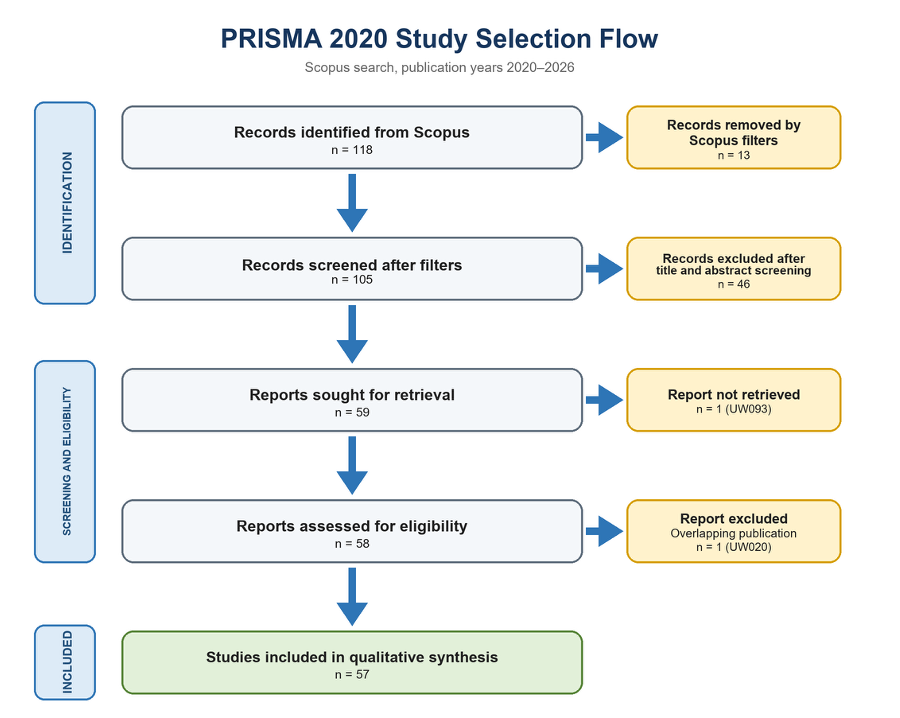
Methods: A Scopus search found 118 records published between 2020 and 2026. After applying language and document type filters, 105 records remained. The screening of titles and abstracts selected 59 reports for full text assessment. Fifty eight reports were obtained and examined. One overlapping report was removed, resulting in 57 studies for the final synthesis. Each study was coded separately and checked using five reporting completeness items.
Results: The review found 20 studies using direct multimodal or multisensor integration, 14 using feature or model fusion within one main modality, 15 using multisource platforms or decision support integration, and 8 using uncertainty, multicriteria decision making, or optimization without direct multimodal fusion. Forty nine studies directly supported RQ1. For RQ2, 28 studies provided direct support and one provided partial support. For RQ3, 56 studies provided direct support and one provided indirect support. Data integration has been applied to various waste management activities. However, uncertainty calibration and source reliability were not regularly evaluated.
Recommendation: Future research should test data integration when some sources are missing or have poor quality. Researchers should also compare confidence values with actual errors, explain the alignment of data across time and location, and relate model results to clear operational decisions and risks.
Abdallah, M., Abu Talib, M., Feroz, S., Nasir, Q., Abdalla, H., & Mahfood, B. (2020). Artificial Intelligence Applications in Solid Waste Management: A Systematic Research Review. Waste Management, 109, 231–246. https://doi.org/10.1016/j.wasman.2020.04.057
Aitimbetova, A., & Pernebayev, Z. (2026). Sustainable Municipal Solid Waste Treatment in a Central Asian City: A Geographic Information System and Scenario-Based Framework for Technology Prioritization in Shymkent, Kazakhstan. Sustainability (Switzerland), 18(11), 5318. https://doi.org/10.3390/su18115318
Akomolafe, D., Klinger, J., Saha, N., Kuns, M., Linck, M., El Zahab, Z., & Bhattacharyya, D. (2026). ClassNMSW- a real-time classification approach for non-recycled municipal solid waste using hyperspectral imaging. Computers and Chemical Engineering, 213, 109742. https://doi.org/10.1016/j.compchemeng.2026.109742
Alfaidz, A. M., Avansyah, H. Z., & Rosmiati, M. (2025). Revolutionizing Waste Management with an IoT Smart Bin Featuring App and Sensor Fusion for Waste Segregation. ICONS-IoT 2025 - International Conference on Networking, Intelligent Systems, and IoT, 135–141. https://doi.org/10.1109/ICONS-IoT65216.2025.11210903
Ali, U., Li, J., Ahmad, Y., Tolasa, F. T., & Senapati, T. (2026). A Decision Support Model for Artificial Intelligence-Based Solid Waste Management Through CRITIC-TOPSIS and Complex Fermatean Fuzzy Structure. International Journal of Computational Intelligence Systems, 19(1), 330. https://doi.org/10.1007/s44196-026-01372-2
Alvi, M., Minerva, R., Dutta, H., Herath, M., & Crespi, N. (2026). A Decision-Support Digital Twin Framework for Sustainable Urban Waste Collection Planning. Process Integration and Optimization for Sustainability. https://doi.org/10.1007/s41660-026-00818-6
Babaee Tirkolaee, E., Mahdavi, I., Seyyed Esfahani, M. M., & Weber, G.-W. (2020). A hybrid augmented ant colony optimization for the multi-trip capacitated arc routing problem under fuzzy demands for urban solid waste management. Waste Management and Research, 38(2), 156–172. https://doi.org/10.1177/0734242X19865782
Bao, L., Zhang, Y., Xue, F., & Zhang, X. (2025). LiteWaste-YOLO: A Super-Resolution-Aware Framework for Urban Waste Detection in Remote Sensing Imagery. 2025 6th International Conference on Big Data, Artificial Intelligence and Internet of Things Engineering, ICBAIE 2025, 285–290. https://doi.org/10.1109/ICBAIE66852.2025.11326552
Behera, M., & Panda, A. C. (2026). A q-rung orthopair fuzzy Gaussian aggregation-based decision-making framework for sustainable solid waste management. Applied Soft Computing, 199, 115381. https://doi.org/10.1016/j.asoc.2026.115381
Bharathi, M., Joshwin Antony, J., Refin, R., & Yokesh, A. (2025). IoT-Based Smart Waste Segregation System with Real-Time Data Analytics and AI for Efficient Waste Management and Recycling. Proceedings ICECONF 2025 - 2025 2nd International Conference on Artificial Intelligence and Knowledge Discovery in Concurrent Engineering. https://doi.org/10.1109/ICECONF65644.2025.11379597
Chandran, N., & Babu, N. R. (2026). Quantum-inspired deep learning model for organic municipal solid waste classification toward a circular bioeconomy. Journal of Environmental Management, 404, 129331. https://doi.org/10.1016/j.jenvman.2026.129331
Cui, C., Yao, J., & Xia, H. (2026). Multilevel Feature Fusion and Nonparametric Detection of Furnace Temperature States in Municipal Solid Waste Incineration Systems. IEEE Transactions on Industrial Informatics, 22(8), 7541–7552. https://doi.org/10.1109/TII.2026.3687100
Dangi, M. B., Malla, O. B., Cohen, R. R. H., Khatiwada, N. R., & Budhathoki, S. (2023). Life cycle assessment of municipal solid waste management in Kathmandu city, Nepal – An impact of an incomplete data set. Habitat International, 139, 102895. https://doi.org/10.1016/j.habitatint.2023.102895
Deepa, T., Kumar, S. N., Kumar, R. H., Lokesh, K., & Joyrishi, T. R. (2026). IoT-based Intelligent Waste Monitoring System using a Hybrid CNN-LSTM Deep Learning Model. Proceedings of 9th International Conference on Inventive Computation Technologies, ICICT 2026, 524–531. https://doi.org/10.1109/ICICT68280.2026.11510935
De-la-Mata-Moratilla, S., Castillo-Martinez, A., Gutierrez-Martinez, J.-M., Ramirez-Velarde, R., & Ferrer-Oliva, M. (2026). Enhancing municipal solid waste management through artificial neural network based forecasting of discharge point behaviour. Knowledge-Based Systems, 350, 116600. https://doi.org/10.1016/j.knosys.2026.116600
Eghtesadifard, M., Afkhami, P., & Bazyar, A. (2020). An integrated approach to the selection of municipal solid waste landfills through GIS, K-Means and multi-criteria decision analysis. Environmental Research, 185, 109348. https://doi.org/10.1016/j.envres.2020.109348
Esmaeilian, B., Wang, B., Lewis, K., Duarte, F., Ratti, C., & Behdad, S. (2018). The Future of Waste Management in Smart and Sustainable Cities: A Review and Concept Paper. Waste Management, 81, 177–195. https://doi.org/10.1016/j.wasman.2018.09.047
Frinifa Babu, B. M., Aarthi, M., Priscilla, R., & Patturose, J. G. B. (2025). YOLO-GreenBin: A Real-Time Multi-Modal Smart Waste Monitoring System using YOLOv8 and Sensor Fusion with Live Geo-Mapping. Proceedings of the 6th International Conference on Electronics and Sustainable Communication Systems, ICESC 2025, 1342–1347. https://doi.org/10.1109/ICESC65114.2025.11212305
Gnanavelu, B., & Murugan, J. (2026). Hybrid fuzzy machine learning model for municipal solid waste forecasting in India. Discover Environment, 4(1), 377. https://doi.org/10.1007/s44274-026-00841-x
Gomathi, P., Anfinston, F. D., Manikandan, S., Gopi, R., Robert, R., & Joseph, S. S. (2026). Hybrid YOLO-CNN Architectures for High-Performance Real-Time Waste Classification in Smart Waste-Management System. ADSSSC 2026 - International Conference on AI-Driven Solutions for Sustainable Smart Cities: Challenges and Opportunities, 566–571. https://doi.org/10.1109/ADSSSC67751.2026.11581951
Guo, C., Zan, I., & Ye, I. (2025). Intelligent Waste Sorting System Based on YOLO-Enhanced Deep Learning Models. Proceedings - 2025 International Conference on Artificial Intelligence, Digital Media Technology and Social Computing, ICAIDS 2025, 87–90. https://doi.org/10.1109/ICAIDS67687.2025.00026
Hassan, S. Z., Sun, P., Gokgoz, M., Chen, J., Reinhart, D. R., & Gustitus-Graham, S. (2023). UAV-based approach for municipal solid waste landfill monitoring and water ponding issue detection using sensor fusion. Journal of Hydroinformatics, 25(6), 2107–2127. https://doi.org/10.2166/hydro.2023.195
Henaien, A., Ben Elhadj, H., & Chaari Fourati, L. (2024). A sustainable smart IoT-based solid waste management system. Future Generation Computer Systems, 157, 587–602. https://doi.org/10.1016/j.future.2024.03.056
Hua, Y., Tang, J., & Tian, H. (2026). Benchmark Operational Condition Multimodal Dataset Construction for the Municipal Solid Waste Incineration Process. Sustainability (Switzerland), 18(5). https://doi.org/10.3390/su18052282
Huang, W., Li, H., Fan, H., & Qian, Y. (2021). Causation mechanism analysis of excess emission of flue gas pollutants from municipal solid waste incineration power plants by employing the Fault Tree combined with Bayesian Network: A case study in Dongguan. Journal of Cleaner Production, 327, 129533. https://doi.org/10.1016/j.jclepro.2021.129533
Ihsanullah, I., Alam, G., Jamal, A., & Shaik, F. (2022). Recent Advances in Applications of Artificial Intelligence in Solid Waste Management: A Review. Chemosphere, 309, 136631. https://doi.org/10.1016/j.chemosphere.2022.136631
Jonuzi, V. M., & Mishkovski, I. (2026). A Multimodal Vision: Language Framework for Intelligent Detection and Semantic Interpretation of Urban Waste. Informatics, 13(4), 57. https://doi.org/10.3390/informatics13040057
Khan, A., Ali, J., & Syam, M. I. (2026). Multi-stage decision support framework under cubic q-rung orthopair fuzzy environment for smart waste management technology selection. Array, 31, 101094. https://doi.org/10.1016/j.array.2026.101094
Kirilchuk, I., Yushin, V., Barkov, A., & Iordanova, A. (2020). Information technologies for risk assessment to public health from emissions of municipal solid waste landfill. International Multidisciplinary Scientific GeoConference Surveying Geology and Mining Ecology Management, SGEM, 2020-August(5.1), 455–462. https://doi.org/10.5593/sgem2020/5.1/s20.058
Kumar, P., Choudhary, M. P., & Mathur, A. K. (2026). Analyzing the relationship between municipal solid waste generation and urban land use using integrated geospatial and spatial statistical techniques. Integrated Environmental Assessment and Management, 22(2), 448–462. https://doi.org/10.1093/inteam/vjaf128
Liu, X., & Zhai, J. (2022). Domestic Waste Sorting System Based on Deep Learning. In Lecture Notes in Electrical Engineering: 803 LNEE (pp. 38–47). https://doi.org/10.1007/978-981-16-6328-4_5
Liu, Y., Zhao, B., Zhang, X., Nie, W., Gou, P., Liao, J., & Wang, K. (2024). A Practical Deep Learning Architecture for Large-Area Solid Wastes Monitoring Based on UAV Imagery. Applied Sciences (Switzerland), 14(5), 2084. https://doi.org/10.3390/app14052084
Lu, G., Wang, Y. B., Xu, H. X., Yang, H. Y., & Zou, J. (2022). Deep multimodal learning for municipal solid waste sorting. Science China Technological Sciences, 65(2), 324–335. https://doi.org/10.1007/s11431-021-1927-9
Ma, S., & Liu, C. (2026). A landscape-aware multi-objective ant colony optimization framework for urban waste collection vehicle routing. Discover Artificial Intelligence, 6(1), 1088. https://doi.org/10.1007/s44163-026-02159-2
Martínez-Ramón, N., Díaz, I., Iribarren, D., & Dufour, J. (2026). Integrated modeling and assessment of municipal solid waste use for aviation decarbonization. Energy Conversion and Management: X, 30, 101809. https://doi.org/10.1016/j.ecmx.2026.101809
Mohammed, M. A., Abdulhasan, M. J., Kumar, N. M., Abdulkareem, K. H., Mostafa, S. A., Maashi, M. S., Khalid, L. S., Abdulaali, H. S., & Chopra, S. S. (2023). Automated waste-sorting and recycling classification using artificial neural network and features fusion: a digital-enabled circular economy vision for smart cities. Multimedia Tools and Applications, 82(25), 39617–39632. https://doi.org/10.1007/s11042-021-11537-0
Mondal, A., Reddy N.R, M., Dubey, B. K., & Yadav, V. (2026). Pathways to sustainable municipal solid waste management: An LCA of integrated approaches and product circularity in Nashik, India. Journal of Environmental Management, 398, 128424. https://doi.org/10.1016/j.jenvman.2025.128424
Navya, N., Inumarthi, S., Snigdha, K., Divya, U., Guttula, T., & Rajesh, J. T. (2025). An Optimized Vision-based Smart Bin for Waste Management Classification System Using Enhanced YOLOv8 Segmentation and Feature Fusion Networks. 3rd International Conference on Emerging Applications of Material Science and Technology, ICEAMST 2025, 1207–1214. https://doi.org/10.1109/ICEAMST67459.2025.11336006
Page, M. J., McKenzie, J. E., Bossuyt, P. M., Boutron, I., Hoffmann, T. C., Mulrow, C. D., Shamseer, L., Tetzlaff, J. M., Akl, E. A., Brennan, S. E., Chou, R., Glanville, J., Grimshaw, J. M., Hróbjartsson, A., Lalu, M. M., Li, T., Loder, E. W., Mayo-Wilson, E., McDonald, S., … Moher, D. (2021). The PRISMA 2020 statement: An updated guideline for reporting systematic reviews. In BMJ (Vol. 372). BMJ Publishing Group. https://doi.org/10.1136/bmj.n71
Pamučar, D., Behzad, M., Božanić, D., & Behzad, M. (2022). Designing a fuzzy decision support framework for assessing solid waste management in the South European region. Environmental Science and Pollution Research, 29(28), 42862–42882. https://doi.org/10.1007/s11356-022-18891-y
Pan, X., Tang, J., Xia, H., & Wang, T. (2023). Online Combustion Status Recognition of Municipal Solid Waste Incineration Process Using DFC Based on Convolutional Multi-Layer Feature Fusion. Sustainability (Switzerland), 15(23), 16473. https://doi.org/10.3390/su152316473
Paulo, D. J., Martins, J., Proença, H., & Neves, J. C. (2026). StreetView-Waste: A Multi-Task Dataset for Urban Waste Management. Proceedings - 2026 IEEE/CVF Winter Conference on Applications of Computer Vision, WACV 2026, 3015–3025. https://doi.org/10.1109/WACV61042.2026.00295
Paulose, A. P., & Augustin, F. (2026). BiAPPSS: an enhanced bipolar fuzzy APPSS framework for sustainable solid waste management. Frontiers in Environmental Science, 14, 1756874. https://doi.org/10.3389/fenvs.2026.1756874
Ram Nivas, D., Sanjeyan, B., Subakarini, S., & Matheshwaran, R. (2026). SmartBin Network: IoT based Waste Monitoring and Data-Driven Decision Support. 2026 International Conference on Innovations in Emerging Technologies for Sustainable Development: Empowering Innovation for a Sustainable Future, ICIETSD 2026 - Conference Proceedings. https://doi.org/10.1109/ICIETSD68684.2026.11584895
Ren, K., Ren, F., & Han, H. (2024). One-Shot Municipal Solid Waste Detection via Object-Relevant Feature Enhancement and Category-Level Feature Fusion. In Communications in Computer and Information Science: 1960 CCIS (pp. 43–53). https://doi.org/10.1007/978-981-99-8761-0_5
Ren, M., Guan, Q., Sun, M., Liu, Y., Qiao, B., & Zhao, H. (2026). Automated detection of hazardous household waste in complex sorting scenarios: A lightweight and high-precision deep learning approach. Waste Management, 223, 115720. https://doi.org/10.1016/j.wasman.2026.115720
Rethlefsen, M. L., Kirtley, S., Waffenschmidt, S., Ayala, A. P., Moher, D., Page, M. J., Koffel, J. B., Blunt, H., Brigham, T., Chang, S., Clark, J., Conway, A., Couban, R., de Kock, S., Farrah, K., Fehrmann, P., Foster, M., Fowler, S. A., Glanville, J., … Young, S. (2021). PRISMA-S: an extension to the PRISMA Statement for Reporting Literature Searches in Systematic Reviews. Systematic Reviews, 10(1). https://doi.org/10.1186/s13643-020-01542-z
Saraiva, A. B., Clímaco, J. N., Valle, R. D. A. B. D., & Mahler, C. (2021). Multi-criteria analysis and consequential lifecycle assessment of solid waste management: An integrated approach. International Journal of Decision Support System Technology, 13(3), 1–17. https://doi.org/10.4018/IJDSST.2021070101
Sharanya, S., Sathyabama, K., Rishikesavan, H., & Saffrin Banu, M. (2025). Edge-Driven Smart Waste Bin Network for Decentralized Urban Waste Management. Proceedings of 2025 International Conference on Signal Processing, Computation, Electronics, Power and Telecommunication, IConSCEPT 2025. https://doi.org/10.1109/IConSCEPT66142.2025.11437363
Shbool, M. A., Al-Bazi, A., Jebril, L. S., Nasrallah, N. M., Al-Amad, S. A., & Al-Souliman, B. O. (2026). Promoting sustainability in Urban waste management in Amman for a circular economy. Journal of Material Cycles and Waste Management, 28(1), 176–198. https://doi.org/10.1007/s10163-025-02405-2
Song, W., Zhao, N., & Ouyang, X. (2026). Municipal Solid Waste Target Detection Algorithm Based on Improved YOLOv11n. IAENG International Journal of Computer Science, 53(5), 1985–1997.
Swan, K. H., Towprayoon, S., & Phongphiphat, A. (2026). Development of a city-level sustainability and resilience index for municipal solid waste management: Methodological framework and application to Bangkok. Environmental and Sustainability Indicators, 31, 101274. https://doi.org/10.1016/j.indic.2026.101274
Tang, J., Wang, T., Tian, H., & Yu, W. (2025). AI- and Security-Empowered End–Edge–Cloud Modular Platform in Complex Industrial Processes: A Case Study on Municipal Solid Waste Incineration. Sensors, 25(22), 6973. https://doi.org/10.3390/s25226973
Teng, J., Guo, S., Wu, W., Yu, J., & Chen, Y. (2026). MSWNet: A Deep Learning Fusion Framework for Municipal Solid Waste Detection From Optical and SAR Images. Transactions in GIS, 30(6), e70376. https://doi.org/10.1111/tgis.70376
Vatsala, G. A., Fathimunnisa, Mudassir, M. S., Vasudeva, G., Jyothi, P., & Rudresha, D. C. (2025). SmartBinX: A Cost-Effective Hybrid AI and SensorBased Autonomous Waste Sorting System for Public Spaces. Proceedings of the 2025 International Conference on Computational Innovations and Sustainable Technologies, ICCIST 2025. https://doi.org/10.1109/ICCIST67338.2025.11438295
Vohra, R., & Mishra, P. (2026). Sustainable mapping identification of municipal solid waste disposal zones using RS-GIS-basedMCDA techniques: a case study in Darjeeling, West Bengal. Environmental Monitoring and Assessment, 198(3), 265. https://doi.org/10.1007/s10661-026-15089-4
Wei, L., Lao, Y., Zhao, Z., Lao, Y., & Qiu, J. (2026). Research on behavioral action control technology for the sorting module of intelligent waste sorting robots in complex waste streams. Proceedings of SPIE - The International Society for Optical Engineering, 14139, 1413908. https://doi.org/10.1117/12.3109047
Wu, C., & Yang, Y. (2026). Dual-stream context aggregation network for waste sorting. Discover Artificial Intelligence, 6(1), 906. https://doi.org/10.1007/s44163-026-01529-0
Xia, H., Tang, J., Pan, X., Yu, W., & Qiao, J. (2024). Multimodal Data-Driven Interpretable Deep Modeling Approach of Dioxins Generation for Municipal Solid Waste Incineration Processes. IEEE Transactions on Instrumentation and Measurement, 73, 1–18. https://doi.org/10.1109/TIM.2024.3476561
Yu, Y., Wang, L., & Peng, Y. (2025). Deep Learning Based Integrated Removable Smart Waste Sorting Device. Proceedings of International Conference on Artificial Life and Robotics, 309–312.
Yu, Y., Zou, S., & Yin, K. (2020). A novel detection fusion network for solid waste sorting. International Journal of Advanced Robotic Systems, 17(5). https://doi.org/10.1177/1729881420941779
Zhang, Z. (2026). Multi-Model Fusion and Data Augmentation for Optimization of Waste Sorting Recognition. 2026 11th International Conference on Electronic Technology and Information Science, ICETIS 2026, 523–527. https://doi.org/10.1109/ICETIS70504.2026.11633384
Adelin Adelin , Faculty of Information Technology, Budi Luhur University, Jakarta, Indonesia
Institut Teknologi dan Bisnis Palcomtech, Palembang, Indonesia