


From Mixed Household Waste to Source-Separated Resource Recovery: Generation, Composition, Density, and Energy Characteristics in Kalibeji Village
Main Article Content
Fakhmi Ziadatul Barqah
Hijrah Purnama Putra
Fajri Mulya Iresha
Background: Rural communities in Indonesia often rely on mixed-waste disposal or incineration despite limited information on the physical, compositional, and energy characteristics of household waste. Understanding these characteristics is essential for developing technically appropriate and resource-oriented waste management systems.
Aims: This study aimed to characterize household waste in Kalibeji Village, Kebumen Regency, Indonesia, and to evaluate a technically appropriate waste management pathway based on waste generation, composition, density, moisture content, ash content, calorific value, and the relationship between household expenditure and waste generation.
Methods: Household waste characterization was conducted over eight consecutive days based on SNI 3964:2025. Waste generation, bulk density, and physical composition were measured, while laboratory analyses were conducted to determine moisture content, ash content, and calorific value. The relationship between monthly household expenditure and waste generation was evaluated using regression analysis.
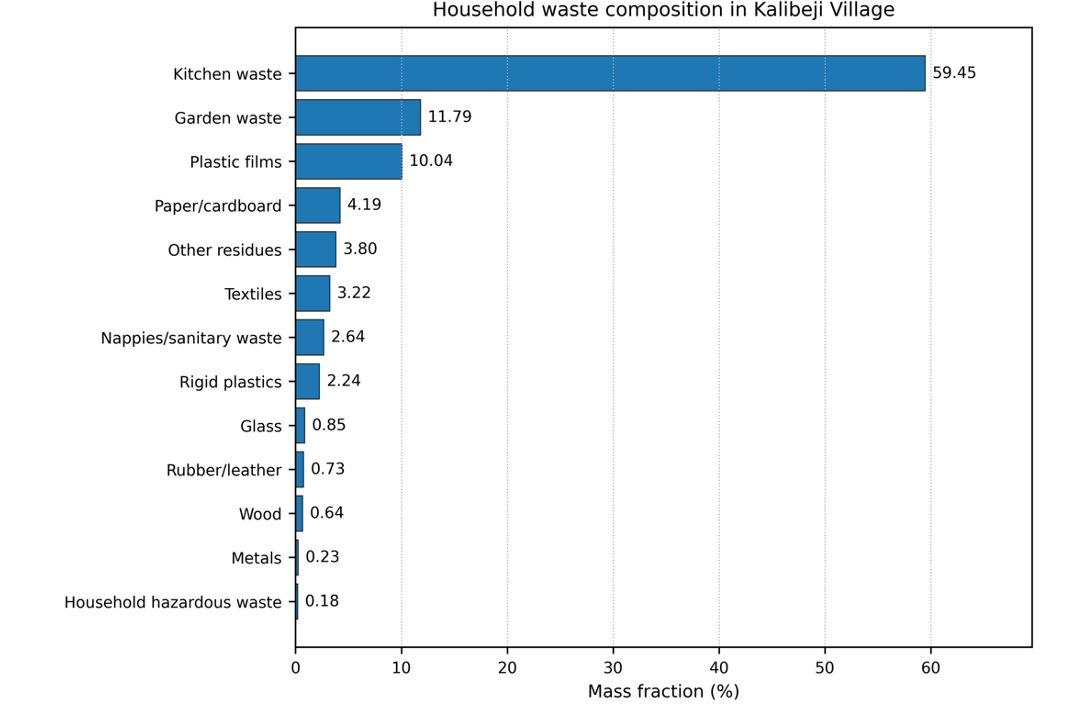
Results: Household waste generation averaged 0.41 kg capita⁻¹ day⁻¹, equivalent to approximately 2.13 t day⁻¹ at the village scale. The average bulk density was 138.59 kg m⁻³. Organic waste dominated the waste stream, accounting for 71.24%. Laboratory analysis indicated a high moisture content of 53.3%, an ash content of 7.75%, and an LHV range of 1,944.78cal g⁻¹. Regression analysis showed a statistically significant positive relationship between household expenditure and waste generation (p = 0.0384). The high proportion of organic waste and moisture content indicates that mixed-waste incineration is not the most technically appropriate primary treatment pathway for Kalibeji Village. A source-separated system should instead prioritize household-scale biological treatment of organic waste through composting or Black Soldier Fly (BSF) bioconversion, recovery of dry recyclables, and controlled handling of residual and household hazardous waste. The study demonstrates that village-scale waste characterization can provide an evidence-based foundation for transitioning from mixed-waste disposal toward an integrated rural resource-recovery system.
Badan Pusat Statistik. (2026). Indikator kesejahteraan rakyat 2025 [Welfare indicators 2025] (Vol. 54). Badan Pusat Statistik.
Alfian, R., & Phelia, A. (2021). Evaluasi efektifitas sistem pengangkutan dan pengelolaan sampah di TPA Sarimukti Kota Bandung. Journal of Infrastructural in Civil Engineering, 2(1), 16–23. https://doi.org/10.33365/jice.v2i01.1084
Aprilia, R., Noerhayati, E., & Rahmawati, A. (2024). Analysis of waste generation characteristics as a reference for TPS 3R planning in community-based waste management efforts. Public Health Risk Assessment Journal, 2(1), 58–70. https://doi.org/10.61511/phraj.v2i1.2024.828
Badan Pusat Statistik Jawa Timur. (2026). Statistik pengeluaran untuk konsumsi rumah tangga Provinsi Jawa Timur 2025 (Vol. 12). Badan Pusat Statistik Provinsi Jawa Timur.
Badan Pusat Statistik Kebumen. (2025). Pengeluaran konsumsi penduduk Kebumen 2024 (Vol. 4). Badan Pusat Statistik Kabupaten Kebumen.
Badan Standardisasi Nasional. (2025). SNI 3964:2025: Metode pengambilan dan pengukuran contoh timbulan dan komposisi sampah rumah tangga dan sampah sejenis sampah rumah tangga. Badan Standardisasi Nasional.
Charkhestani, A., & Kebria, D. Y. (2022). Laboratory analysis to determine the accurate characteristics of urban food waste. Global Journal of Environmental Science and Management, 8(2), 225–236. https://doi.org/10.22034/GJESM.2022.02.06
Chen, Y. (2023). Study on waste incineration and electricity conversion in Macau, China. Asian Journal of Mechatronics and Electrical Engineering, 2(1), 19–36. https://doi.org/10.55927/ajmee.v2i1.2434
Citrasari, N., Rachman, I., & Matsumoto, T. (2025). Methane emissions from Indonesian landfills: Site conditions, scientific evidence, and environmental risks. International Journal of Scientific Advances, 6(3), 446–463. https://doi.org/10.51542/ijscia.v6i3.7
Dorfmann, R. (1985). Les résidus urbains: Traitement et valorisation (Vol. 2). Technique et Documentation–Lavoisier.
Exposto, L. A. S., & Januraga, P. P. (2021). Domestic waste characteristics and the management systematic review. International Journal of Health & Medical Sciences, 4(2), 253–259. https://doi.org/10.31295/ijhms.v4n2.1731
Fasya, A. H. Z., Ibad, M., El Muna, K. U. N., Pratiwi, S. F., & Arum, S. A. S. (2025). A systematic review of solid waste management in Indonesia: Generation, characteristics, treatment, and regulation. Jurnal Kesehatan Lingkungan, 17(4), 333–342. https://doi.org/10.20473/jkl.v17i4.2025.333-342
Finnveden, G., Johansson, J., Lind, P., & Moberg, Å. (2005). Life cycle assessment of energy from solid waste—Part 1: General methodology and results. Journal of Cleaner Production, 13(3), 213–229. https://doi.org/10.1016/j.jclepro.2004.02.023
Fitri, S. E., & Ferza, R. (2020). Dinamika, problematika, dan implikasi kebijakan pengelolaan sampah plastik (studi kasus Kota Bogor dan Kota Bekasi). Jurnal Kebijakan Pembangunan, 15(1), 11–24. https://doi.org/10.47441/jkp.v15i1.40
Gustannanda, S. A., Hidayah, E. N., & Farahdiba, A. U. (2023). Kuantitas dan karakteristik sampah bahan pangan: Studi kasus Surabaya Selatan. INSOLOGI: Jurnal Sains dan Teknologi, 2(1), 89–96. https://doi.org/10.55123/insologi.v2i1.1398
Hapsari, D. S. A., & Herumurti, W. (2017). Laju timbulan dan komposisi sampah rumah tangga di Kecamatan Sukolilo Surabaya. Jurnal Teknik ITS, 6(2), C421–C424. https://doi.org/10.12962/j23373539.v6i2.24623
Hoang, G. M., Ha, H. T. T., Le, N. T. L., & Toan, N. D. (2024). Evaluation of municipal waste collection performance using operational data. Global Journal of Environmental Science and Management, 10(1), 69–82. https://doi.org/10.22034/gjesm.2024.01.06
Lawa, J. I. J., Mangangka, I. R., & Riogilang, H. (2021). Perencanaan Tempat Pengolahan Sampah (TPS) 3R di Kecamatan Mapanget Kota Manado. Jurnal TEKNO, 19(78), 77–89.
Lorenta In, H., Raihan, I., Ayuni, J. D., Salmah, Surya, R. M., & Fadhillah, H. (2023). Utilization of black soldier fly's larvae for integrated waste management at farmer household. RJOAS: Russian Journal of Agricultural and Socio-Economic Sciences, 5(137). https://doi.org/10.18551/rjoas.2023-05.06
Pemerintah Republik Indonesia. (2008). Undang-Undang Nomor 18 Tahun 2008 tentang Pengelolaan Sampah.
Qonitan, F. D., Suryawan, I. W. K., & Rahman, A. (2021). Overview of municipal solid waste generation and energy utilization potential in major cities of Indonesia. Journal of Physics: Conference Series, 1858, Article 012064. https://doi.org/10.1088/1742-6596/1858/1/012064
Ratya, H., & Herumurti, W. (2017). Timbulan dan komposisi sampah rumah tangga di Kecamatan Rungkut Surabaya. Jurnal Teknik ITS, 6(2), C451–C453. https://doi.org/10.12962/j23373539.v6i2.24675
Riswan, Sunoko, H. R., & Hadiyarto, A. (2011). Pengelolaan sampah rumah tangga di Kecamatan Daha Selatan. Jurnal Ilmu Lingkungan, 9(1), 31–38. https://doi.org/10.14710/jil.9.1.31-38
Shofi, N. C., Auvaria, S. W., Nengse, S., & Karami, A. A. (2023). Analisis aspek teknis pengelolaan sampah di Tempat Pengolahan Sampah Reduce, Reuse, Recycle (TPS 3R) Desa Janti Kecamatan Waru Sidoarjo. Jurnal Teknik Sipil dan Lingkungan, 8(1), 1–8. https://doi.org/10.29244/jsil.8.1.1-8
Survase, N. M., Thorat, S. S., Wani, M. R., Bhargude, S. R., Kalaskar, P. P., & Jagtap, S. U. (2025). Solid waste management in Narhe Village: A case study. International Journal of Science and Research Archive, 15(3), 494–499. https://doi.org/10.30574/ijsra.2025.15.3.1251
Udousoro, I. I., Onuchukwu, S. C., & Umorena, I. U. (2026). Assessment of electronic waste for heavy metal contamination and its impacts on ecosystem health. Environmental Pollution and Management, 3, 1–10. https://doi.org/10.1016/j.epm.2025.09.003